
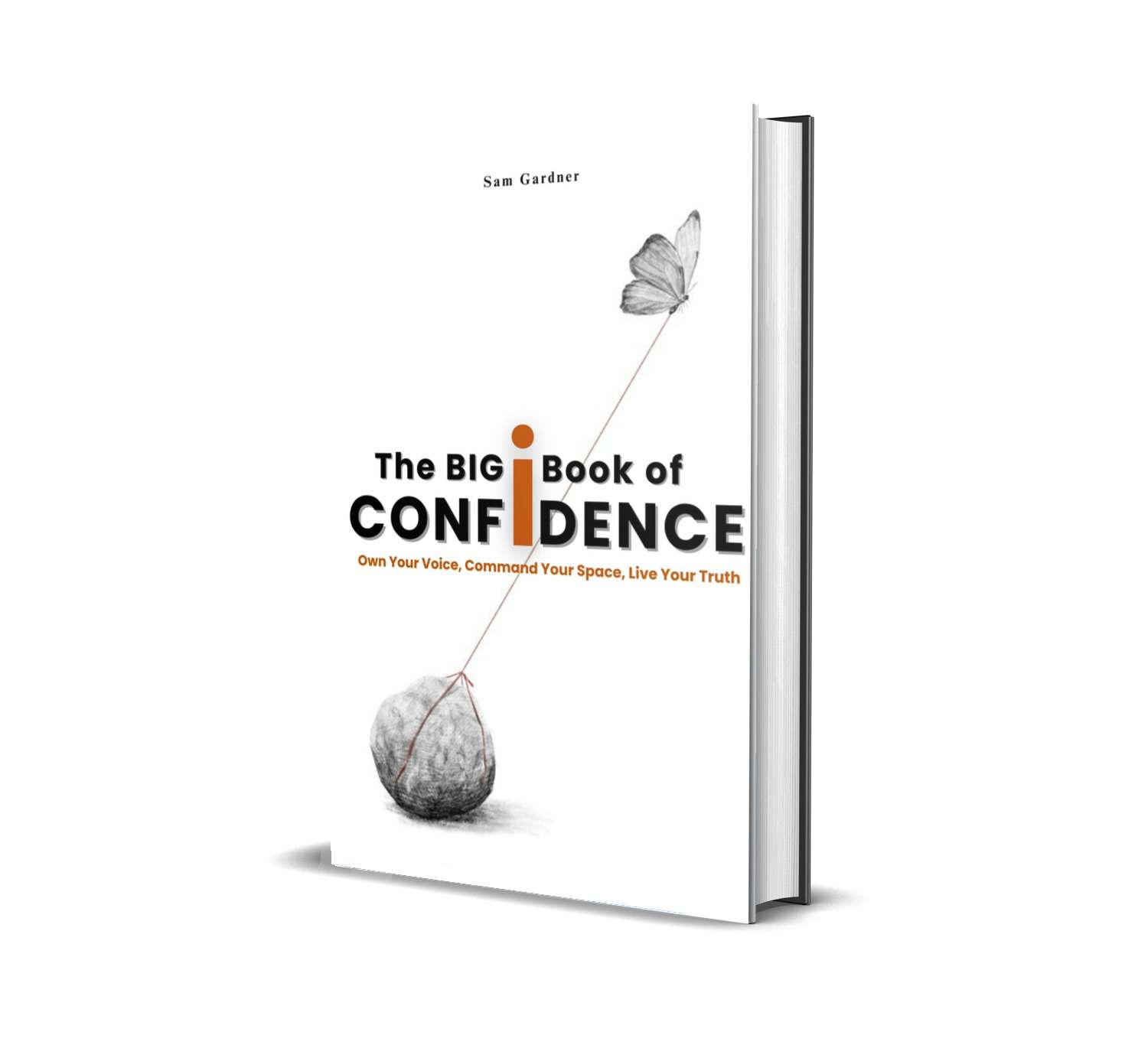
The Definitive Guide to Building Confidence: A Review of Sam Gardner’s ‘The Big Book of Confidence’
Introduction: The Imperative of Building Confidence in the Modern World
In a world defined by constant connectivity and relentless self-comparison, the ability to project self-assurance, articulate one’s values, and occupy physical and virtual spaces with genuine presence has never been more crucial. Confidence, once viewed merely as a desirable personality trait, is now recognized as the foundational skill set necessary for professional achievement, fulfilling relationships, and profound personal contentment. Yet, for many, the path to sustained self-belief remains elusive, littered with transient fixes and fleeting motivational highs. The concept of Building Confidence requires a methodology—a comprehensive, actionable framework—that transcends simple positive thinking and delves into the mechanics of self-perception and external expression.
The Big Book of Confidence

- Author
- Sam Gardner
- Published
- 2025
- Pages
- 335
- Subject
- Self-Help, Confidence
- ISBN-13
- 979-8276383880
It is into this landscape that Sam Gardner, a compelling new voice from New York, has introduced his formidable work, The Big Book of Confidence: Own Your Voice, Command Your Space, Live Your Truth. Published independently, this book—all 335 pages of it—is positioned not as a momentary surge of inspiration, but as a complete manual for total self-transformation. Gardner’s promise is grand: to provide the reader with the tools to fundamentally alter their relationship with fear, doubt, and social anxiety, replacing them with measurable, sustainable, and demonstrable self-trust. This detailed review explores how Gardner delivers on that promise and why his book is set to become an indispensable resource for anyone serious about the lifelong project of Building Confidence.

Live Your Truth
Master the Art of **Building Confidence** and commanding any room.
The Big Book of Confidence
Own Your Voice, Command Your Space, Live Your Truth
By Sam Gardner | 335 pages | Published 2025-11-27
Why ‘The Big Book of Confidence’ is Essential for Building Confidence and Self-Mastery
While the self-help market is saturated with titles promising quick fixes for insecurity, Gardner’s The Big Book of Confidence distinguishes itself through its sheer breadth, its psychological depth, and its uncompromising focus on practice. This book is not for the passive reader; it is a Building Confidence workshop in print form, structured around the three core pillars of Own Your Voice, Command Your Space, and Live Your Truth.
The Three-Dimensional Approach to Building Confidence
Most books tackle confidence from a single perspective: either the mental (mindset shifts), the emotional (overcoming fear), or the behavioral (body language). Gardner’s masterwork, however, recognizes that true self-assurance is a holistic, multi-dimensional construct. He integrates cognitive-behavioral techniques (CBT) for managing internal dialogue, physical and somatic exercises for mastering external presence, and existential principles for anchoring identity in core values. This tripartite structure ensures that readers are not just thinking confidently, but behaving confidently, and, most importantly, being confident. The meticulous detail, spanning 335 pages, allows Gardner to dedicate entire sections to subjects often glossed over, such as the psychology of assertiveness in difficult negotiations, the biomechanics of charismatic posture, and the ethical dilemmas of vulnerability in leadership.
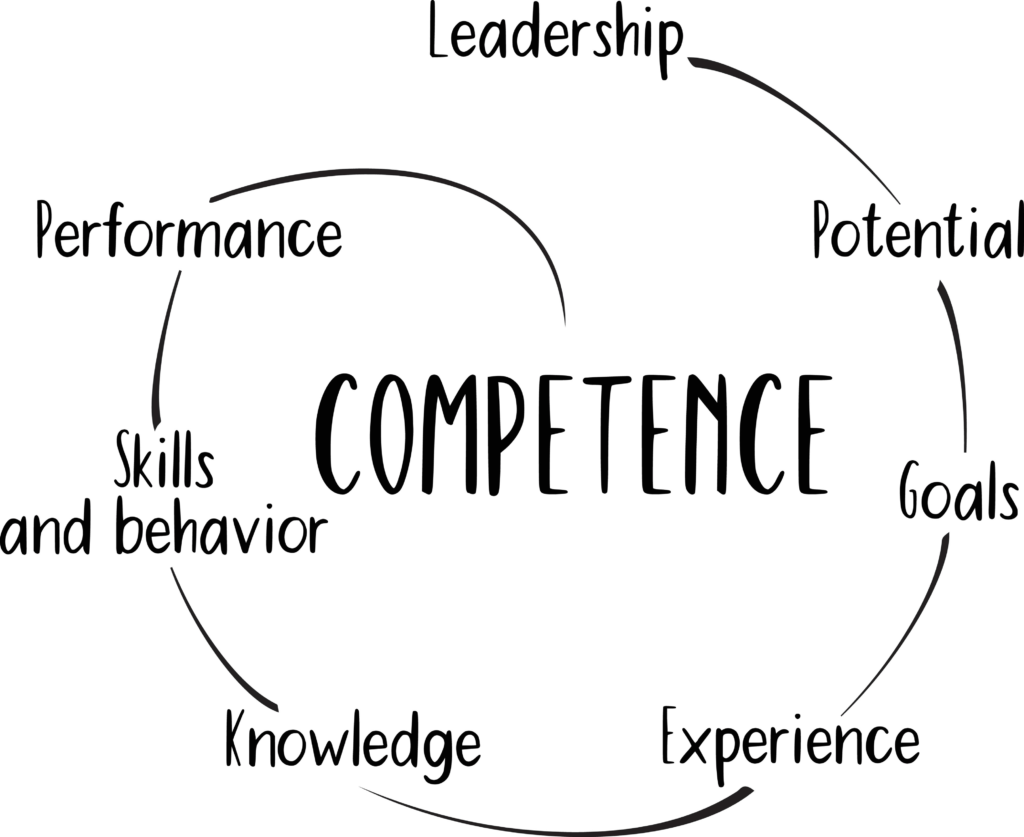
This concept visually represents how taking action (Command Your Space) builds real skill (Competence), which in turn fuels genuine self-belief (Confidence).
The Focus on Sustainable Building Confidence
Gardner’s most valuable contribution to the genre is his relentless emphasis on durability. He argues compellingly that confidence must be built through repeatable, measurable actions—not simply fleeting moments of emotional euphoria. The book is packed with over 50 specific exercises, journaling prompts, and 7-day challenges designed to hardwire new neural pathways. For instance, the section on “The Inner Critic” doesn’t just suggest silencing negative self-talk; it introduces a structured, four-step methodology for dialoguing with, neutralizing, and finally, re-tasking the inner critic into an “Inner Coach.” This focus on structured, repeated effort makes the process of Building Confidence feel less like a talent and more like a skill—a skill anyone can acquire.
The sheer volume of content—335 pages of deep instruction—justifies the title and signals the gravity of the subject. This is the book for individuals who have tried other confidence quick-reads and found the results lacking. It is a comprehensive system for lasting change.
Sam Gardner: The Voice Guiding Your Journey to Building Confidence

Sam Gardner, based in New York, brings a refreshing blend of metropolitan pragmatism and deep psychological insight to the self-help space. While relatively new to the independent publishing scene (with the book published on November 27, 2025, via KDP, ISBN-13: 979-8276383880), Gardner’s voice is remarkably seasoned and authoritative. The style suggests a professional background rooted in high-stakes environments—perhaps executive coaching, theatrical training, or clinical behavioral therapy—where measurable results and peak performance are paramount.
Gardner’s narrative is peppered with anecdotes that feel less like abstract parables and more like real-world case studies of successful business leaders, creatives, and public figures navigating extreme self-doubt. These examples solidify his credibility, positioning him not as a motivational guru, but as an astute observer of human behavior and a master strategist for self-improvement. He is unapologetic about the effort required for Building Confidence, yet deeply empathetic to the struggle. His prose is clean, direct, and urgent, pushing the reader forward with firm encouragement rather than gentle persuasion. This clarity and confidence in his own writing mirror the qualities he implores his readers to adopt.
Deep Dive: Unpacking the Pillars of Building Confidence
Live Your Truth
Master the Art of **Building Confidence** and commanding any room.
The Big Book of Confidence
Own Your Voice, Command Your Space, Live Your Truth
By Sam Gardner | 335 pages | Published 2025-11-27
The Big Book of Confidence is structured into four major movements, each dedicated to a critical facet of self-assurance. The book’s 335 pages are utilized efficiently, moving seamlessly from psychological theory to tactical implementation.
Part I: Own Your Voice (The Assertiveness and Communication Module)
Gardner begins by dissecting communication anxiety, arguing that an “unowned” voice is the primary symptom of a confidence deficit. This section is a masterclass in assertiveness training, moving beyond simple “I feel” statements to cover:
- The Assertive Scripting Method (ASM): A formulaic approach for drafting high-stakes conversations (negotiations, boundary-setting) that ensures clarity, respect, and non-negotiable personal protection.
- The Power of Pauses: Detailed analysis of vocal cadence, volume modulation, and the strategic use of silence to convey authority, a profound technique for Building Confidence in public speaking.
- Affiliate Book Note: This section complements the classic advice found in Dale Carnegie’s How to Win Friends and Influence People by providing the psychological bedrock needed to apply those social tactics from a place of genuine self-worth, rather than mere manipulation.
Part II: Command Your Space (The Physical Presence and Posture Module)
This movement is perhaps the book’s most distinctive contribution. Gardner insists that confidence is a physical act, not just a mental one. He dedicates extensive chapters to the biomechanics of presence:
- The Gravity Protocol: A series of physical exercises designed to anchor the body and eliminate “fidgeting tells” that betray nervousness. This includes detailed instruction on seated posture, walking gait, and the appropriate use of hand gestures.
- Territorial Confidence: The concept of consciously using one’s physical space—whether a boardroom or a virtual meeting screen—to project authority. This involves practical tips on everything from where to place objects to how long to maintain eye contact. The detailed approach to mastering one’s non-verbal communication is invaluable for Building Confidence in high-pressure situations.
Part III: Live Your Truth (The Authenticity and Value-Anchoring Module)
Gardner pivots inward here, focusing on the existential foundation of self-trust. He argues that genuine, unshakable confidence is impossible if one is living a lie or consistently violating one’s own core principles.
- The Value Alignment Audit (VAA): A challenging, multi-chapter journaling process designed to help the reader identify their top five non-negotiable personal values (e.g., Integrity, Courage, Creativity). Gardner then provides a rubric for scoring daily actions against these values. A high VAA score, he posits, is the ultimate measure of true confidence.
- The Vulnerability Strategy: Unlike the often-mushy advice on “being vulnerable,” Gardner provides a strategic, risk-managed approach, explaining when and how much to reveal to foster deeper connection without sacrificing professional authority. This section strongly echoes the work of Brené Brown, particularly The Gifts of Imperfection, and serves as a powerful psychological component for Building Confidence.
Part IV: The Action Habit (The Resilience and Anti-Procrastination Module)
The final section is dedicated entirely to implementation. It bridges the gap between theoretical self-assurance and consistent daily execution. Gardner introduces his unique Confidence methodology built around the 40% Rule concept popularized by David Goggins in Can’t Hurt Me, but reframed through a psychological lens:
- The Micro-Failure Calibration: A technique for deliberately undertaking small, safe risks where failure is guaranteed, solely for the purpose of practicing the recovery process. This normalizes failure and demystifies the fear of social judgment, accelerating the process of Building Confidence.
- Affiliate Book Note: For readers seeking a highly tactical, acceptance-based complement to this section, Russ Harris’s The Confidence Gap provides excellent ACT (Acceptance and Commitment Therapy) tools that align seamlessly with Gardner’s focus on taking action with fear, not without it.
Comparision Table: Sam Gardner vs. Self-Help Giants in Building Confidence
Gardner’s work stands on the shoulders of giants but offers a distinct and often more rigorous methodology. The table below highlights where The Big Book of Confidence excels compared to other seminal works on Building Confidence.
| Book Title | Author | Core Focus/Discipline | Primary Contribution to Building Confidence | Gardner’s Differentiating Factor |
|---|---|---|---|---|
| The Big Book of Confidence | Sam Gardner | CBT, Somatics, Existentialism | Holistic, three-dimensional system (Voice, Space, Truth) with granular exercises. | Integration: Unifies cognitive, physical, and value-based confidence building into a single, massive playbook. |
| The Six Pillars of Self-Esteem | Nathaniel Branden | Psychology, Philosophy | Defines the psychological and philosophical foundations of self-esteem (living consciously, self-acceptance, etc.). | Action-Oriented: Branden provides the why; Gardner provides the how and what to do immediately after reading. |
| Feel the Fear and Do It Anyway | Susan Jeffers | Mindset, Affirmations | Teaches readers to neutralize paralyzing fear and take action despite anxiety. | Depth of Skill: Gardner offers specific physical and verbal scripts (ASM, Gravity Protocol) beyond general motivational principles. |
| The Confidence Code | Kay & Shipman | Socio-Psychology, Research (Women) | Examines the confidence gap in women, using research to push for active decision-making and risk-taking. | Universal Application: While excellent for women, Gardner’s principles are gender-neutral and focus more heavily on physical presence and communication technique. |
| You Are a Badass | Jen Sincero | Motivational, Transformational | High-energy push to adopt a “badass” mindset and overcome self-sabotage through high self-love. | Structured Practice: Gardner is less about motivation and more about method. He provides daily routines and measurable accountability metrics. |
Key Take Ways: Actionable Insights for Building Confidence from Gardner’s Work
Live Your Truth
Master the Art of **Building Confidence** and commanding any room.
The Big Book of Confidence
Own Your Voice, Command Your Space, Live Your Truth
By Sam Gardner | 335 pages | Published 2025-11-27
The true value of The Big Book of Confidence lies in its highly specific, repeatable action items. Gardner’s work is densely packed, but several core techniques stand out as immediate game-changers for those committed to Building Confidence.
1. The 3-Second Rule for Assertiveness
Gardner formalizes the response time in social situations. If a challenge, question, or invitation for contribution arises, you must respond or begin speaking within three seconds. He explains that the anxiety-generating loop begins after this window. By committing to the 3-Second Rule, you force the prefrontal cortex to bypass the amygdala’s fear response, thereby immediately and repeatedly practicing the habit of assertiveness, which is crucial for Building Confidence.
2. Postural Power Shifts (The “Widen and Ground” Exercise)
Before any high-stakes interaction (a pitch, a difficult meeting, a date), Gardner recommends a two-minute grounding exercise:
- Widen: Consciously expand your shoulders and chest, imagining creating more horizontal space. This counters the universal human instinct to contract under stress.
- Ground: Focus your weight entirely on your feet, slightly shifting your center of gravity down. This somatic anchor reduces mental drift and fosters a sensation of physical stability and calm. This simple technique is one of the quickest methods for external Building Confidence signals.
3. The Reverse Rejection Journal
This journaling prompt is revolutionary for neutralizing the fear of failure. Instead of focusing on successes, the reader is instructed to document:
- The Bold Action Taken: (e.g., Asked for the promotion.)
- The Negative Outcome: (e.g., Was rejected.)
- The Actual Cost: (e.g., None. The sun still rose. My job is secure. The manager was polite.)
By constantly recording that the subjective fear of rejection is exponentially worse than the objective reality of the outcome, the brain is slowly reprogrammed, making the next bold action easier. This is core to Building Confidence through exposure therapy.
4. The Integrity Metric
Gardner’s most profound takeaway is the link between integrity and confidence. He mandates that readers pick one small, non-essential promise they routinely break (e.g., promising to read a chapter, promising to reply to an email immediately) and commit to fulfilling it 100% of the time for 30 days. He argues that the internal violation of self-trust through small broken promises is what erodes self-esteem. By rebuilding micro-integrity, one repairs the internal trust that is the ultimate source of Building Confidence.
Conclusion: The Lasting Impact of The Big Book of Confidence
Live Your Truth
Master the Art of **Building Confidence** and commanding any room.
The Big Book of Confidence
Own Your Voice, Command Your Space, Live Your Truth
By Sam Gardner | 335 pages | Published 2025-11-27
Sam Gardner’s The Big Book of Confidence: Own Your Voice, Command Your Space, Live Your Truth is a necessary, albeit intimidatingly comprehensive, addition to the self-help canon. It is a dense, 335-page commitment (ASIN: B0G498B7M2, Dimensions: 6 x 0.76 x 9 inches) but one that yields profound, measurable returns. Gardner meticulously dismantles the notion that confidence is an inherent gift, establishing it firmly as a cultivated skill, refined through disciplined practice.
This book is the antithesis of the surface-level confidence boost. It is a long-term strategy for self-reconstruction, demanding that readers face their vulnerabilities and execute the prescribed behavioral and psychological shifts. For the individual serious about making a permanent change, who recognizes that true self-mastery requires both mental fortitude and physical presence, The Big Book of Confidence is the blueprint. It doesn’t just promise you’ll feel better; it provides the robust, actionable architecture for Building Confidence that will genuinely allow you to own your voice, command your space, and ultimately, live your undeniable truth.
If you’re looking for more great resources on personal development and self-assurance, check out this video: 3 Books That Will 10X Your Self Confidence. This video highlights essential reads that complement Gardner’s rigorous approach to Building Confidence.