
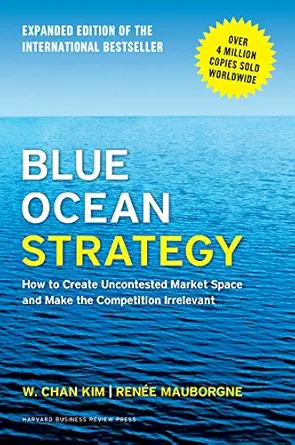
Blue Ocean Strategy
Blue Ocean Strategy: Escape Competition & Create Uncontested Market Space
How to stop fighting over shrinking profit pools and create new market space that makes competition irrelevant

Stop competing in crowded red oceans – create your own blue ocean instead
In today’s hyper-competitive business landscape, companies fight tooth and nail for market share in increasingly crowded industries. This “red ocean” of competition is characterized by bloody battles where products become commoditized, margins shrink, and growth stagnates.
But what if there was a different way? What if instead of fighting over existing demand, you could create and capture new demand? This is the fundamental premise of Blue Ocean Strategy, the groundbreaking business framework developed by W. Chan Kim and Renée Mauborgne.
What is Blue Ocean Strategy?
Blue Ocean Strategy is a business theory that argues that market boundaries and industry structure are not predetermined but can be reconstructed by the actions and beliefs of industry players. Instead of competing in existing market space (red oceans), companies should create uncontested market space (blue oceans) that make competition irrelevant.
The Core Concept: Red Oceans vs. Blue Oceans
To understand Blue Ocean Strategy, we must first distinguish between red oceans and blue oceans:
Red Oceans
Existing industries with defined and accepted boundaries
Competition-based strategy: Beat the competition
Exploit existing demand
Make the value-cost trade-off
Align the whole system of activities with strategic choice of differentiation or low cost
Blue Oceans
Untapped market spaces with creation of new demand
Make competition irrelevant
Create and capture new demand
Break the value-cost trade-off
Align the whole system of activities in pursuit of differentiation and low cost
“The only way to beat the competition is to stop trying to beat the competition.”
The Four Actions Framework: Creating Your Blue Ocean
At the heart of Blue Ocean Strategy is the Four Actions Framework, a tool designed to help businesses reconstruct buyer value elements and create new value curves. This framework poses four key questions:

The Four Actions Framework helps systematically create new value curves
1. Eliminate
Which factors that the industry takes for granted should be eliminated? These are elements that no longer have value or may even detract from value.
2. Reduce
Which factors should be reduced well below the industry’s standard? These are elements that have been over-designed in the race to beat the competition.
3. Raise
Which factors should be raised well above the industry’s standard? These are elements that should be strengthened to create new value.
4. Create
Which factors should be created that the industry has never offered? These are entirely new sources of value that can create new demand.
Example: Cirque du Soleil
Cirque du Soleil created a blue ocean by eliminating costly elements of traditional circuses (star performers, animal shows), reducing emphasis on fun and humor, raising artistic elements and refinement, and creating themes and multiple productions.
The Six Principles of Blue Ocean Strategy
Kim and Mauborgne outline six principles that underpin the successful formulation and execution of blue ocean strategies:
1. Reconstruct Market Boundaries
Look across alternative industries, strategic groups, buyer groups, complementary offerings, functional-emotional orientation, and time to find new market space.
2. Focus on the Big Picture, Not the Numbers
Use a visual approach to strategy development that engages people throughout the organization.
3. Reach Beyond Existing Demand
Focus on noncustomers rather than just segmenting existing customers.
4. Get the Strategic Sequence Right
Ensure your blue ocean idea has commercial viability by following the sequence of buyer utility, price, cost, and adoption.
5. Overcome Key Organizational Hurdles
Address cognitive, resource, motivational, and political hurdles that can block execution.
6. Build Execution into Strategy
Make strategy execution an intrinsic part of strategy formulation through fair process.
Case Study: Yellow Tail Wine
Yellow Tail didn’t just create another wine brand – it created a new market space by making wine accessible to everyday beer and cocktail drinkers. By eliminating the complexities of wine (oenological terminology, aging qualities), reducing the wine range, raising ease of drinking and fun, and creating a playful personality, Yellow Tail became the fastest growing wine brand in history.
How to Apply Blue Ocean Strategy in Your Business
Actionable Steps to Create Your Blue Ocean
- Start with a Strategy Canvas: Map your current competitive position relative to competitors on key success factors.
- Identify Non-Customers: Analyze why people don’t use your industry’s offerings and what would attract them.
- Apply the Four Actions Framework: Systematically eliminate, reduce, raise, and create factors to develop a new value curve.
- Develop Your Blue Ocean Idea: Create a compelling tagline that captures the essence of your new value proposition.
- Test for Commercial Viability: Ensure your idea has exceptional utility, is strategically priced, meets your cost target, and addresses adoption hurdles.
- Execute with Fair Process: Engage people in the strategy process through engagement, explanation, and expectation clarity.

Blue Ocean Strategy requires cross-functional collaboration and fresh thinking
Common Pitfalls to Avoid
While Blue Ocean Strategy offers tremendous potential, many implementations fail due to common mistakes:
Mistake 1: Confusing Technology Innovation with Value Innovation
Blue oceans aren’t about technology breakthroughs but value breakthroughs. The innovation must be tied to exceptional buyer utility.
Mistake 2: Overfocus on Blue Ocean Ideation at the Expense of Execution
A great blue ocean idea without proper execution remains just an idea. The strategy must address organizational hurdles.
Mistake 3: Equating Creative Differentiation with Blue Ocean Strategy
Being different isn’t enough – the differentiation must create new utility while simultaneously lowering costs.
Mistake 4: Communicating the Blue Ocean Idea Poorly
If people inside and outside your organization can’t grasp your new value proposition quickly, adoption will suffer.
Ready to Dive In?
Blue Ocean Strategy isn’t just for large corporations – businesses of all sizes can apply these principles. The key is to shift your mindset from competing to creating.
Beyond Business: Applying Blue Ocean Thinking to Life
The principles of Blue Ocean Strategy extend far beyond business. You can apply them to your career, relationships, and personal growth:
- Career: Instead of competing for the same jobs as everyone else, create a unique role that combines your distinctive skills in new ways.
- Personal Development: Rather than following conventional self-improvement paths, design a personal growth strategy that eliminates activities with little return, reduces time on maintenance tasks, raises focus on high-impact activities, and creates new habits that serve your unique aspirations.
- Problem-Solving: Apply the Four Actions Framework to personal or organizational challenges to find innovative solutions that break conventional trade-offs.
“The business universe has no permanent superior or inferior positions. It’s constantly changing, with blue oceans continually being created and red oceans continually being diluted.”
Blue Ocean Strategy represents a fundamental shift in strategic thinking – from competition-focused to creation-focused. By systematically applying its principles and tools, you can escape the bloody competition of red oceans and create your own blue ocean of uncontested market space.
The question is no longer whether blue oceans exist – we have ample evidence that they do. The real question is: Will you have the courage and insight to create one?